
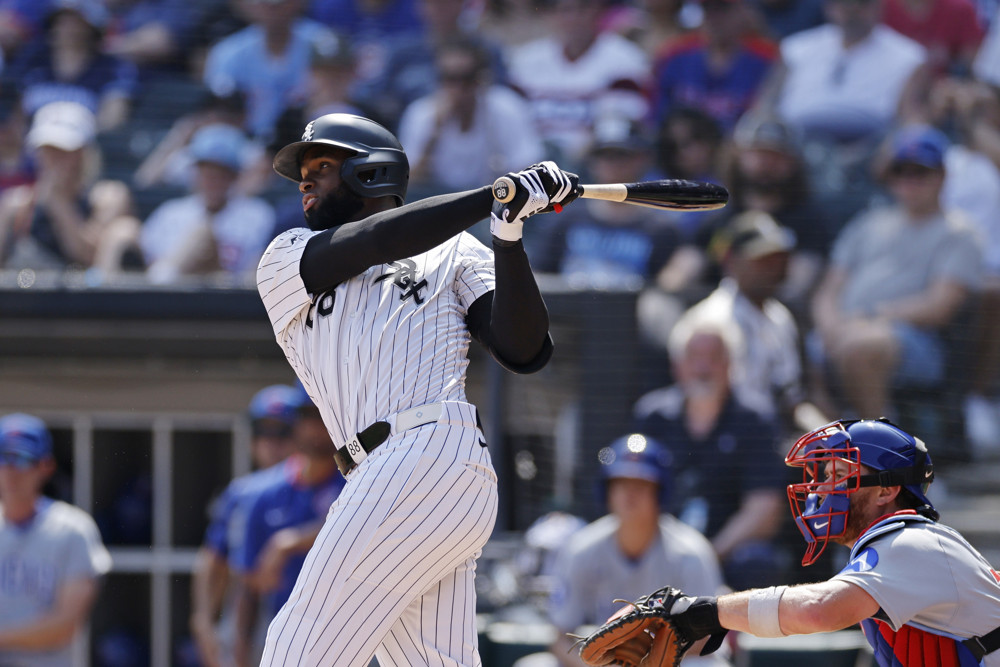
In a late-night transaction that officially closes the book on one of the most disappointing eras in White Sox history, Chicago has traded center fielder Luis Robert Jr. to the New York Mets in exchange for infielder Luisangel Acuña and right-handed pitching prospect Truman Pauley, the clubs announced Tuesday night.
Robert, 28, was the final piece remaining from a White Sox core that once featured Yoan Moncada, Andrew Vaughn, Eloy Jimenez, Tim Anderson, and Jose Abreu—a group that was supposed to deliver championships to the South Side but instead became synonymous with underachievement and frustration.
The Mets are taking on the entirety of Robert's $20 million salary for 2026, according to ESPN's Jeff Passan. Robert also has a $20 million club option with a $2 million buyout for 2027 before he can become a free agent.
The Robert Era: Flashes of Brilliance, Struggles with Consistency
When Luis Robert Jr. was at his best, he looked like one of the most dynamic players in baseball. His 2023 campaign stands as proof of what could have been—a season that MLB.com described as "one of the most complete seasons in White Sox history."
That year, the five-tool talent slashed .264/.315/.542 with 38 home runs, 36 doubles, 20 stolen bases, 90 runs scored, and 80 RBIs across 145 games. He earned All-Star honors, finished 12th in MVP voting, and took home a Silver Slugger award. His OPS+ of 130 was among the best in the American League, and he looked every bit the franchise cornerstone the White Sox had envisioned when they signed him as an international free agent.
But that magical 2023 season proved to be an outlier rather than the new normal. Over the 2024 and 2025 campaigns, Robert's production cratered. He posted a combined .660 OPS with just 28 home runs across 210 games—numbers that fell well short of expectations for a player earning $20 million annually.
His six-year career with the White Sox concludes with a .259/.313/.455 slash line, 102 home runs, and 102 stolen bases over 577 games—respectable numbers, but far from the superstar production Chicago had hoped for when they committed to him long-term.
Health Concerns Cast Shadow Over Talent
Perhaps more than any statistical shortcoming, injuries defined Robert's tenure on the South Side. MLB.com noted that "health has been the biggest issue for the 28-year-old Cuban," a reality that became painfully clear during the 2025 season.
Robert was limited to just 110 games last year after suffering a pair of left hamstring strains. His second strain sidelined him from August 26 through the end of the White Sox' 2025 season. The year prior, Chicago had set the modern Major League Baseball record with 121 losses in 2024. Robert appeared in just 100 games that season after missing nearly two months with a right hip flexor strain.
When healthy, Robert remains an excellent athlete and defensive presence in center field. He set a career-high with 33 stolen bases in 2025, showcasing the speed that made him such an intriguing prospect.
What the Mets Are Getting
For the Mets, this trade represents a calculated gamble on a player who's three years removed from elite production. New York has undergone a massive roster overhaul this offseason after an 83-79 finish left them just short of a postseason berth.
Five days before the Robert trade, the Mets announced their three-year, $126 million contract with free agent infielder Bo Bichette. Combined with earlier additions of Jorge Polanco, Marcus Semien, and relievers Devin Williams and Luke Weaver, the Mets have dramatically reshaped their roster.
ESPN's Jeff Passan noted that Robert "lined up as a strong fit for a Mets team starting to take shape. With stars Francisco Lindor and Juan Soto atop the lineup, they have backfilled with a handful of professional hitters in Bichette, Polanco and Semien, allowing them to take a shot on Robert unleashing his dynamism at Citi Field."
The financial commitment is substantial. The deal pushes the Mets' payroll to approximately $350 million, and with them exceeding the top threshold of the competitive balance tax, they'll pay a 110% penalty on additional salary—making the true cost for Robert approximately $42 million in 2026, according to ESPN.
Center field has been a revolving door for the Mets in recent years. The team cycled through Harrison Bader, Tyrone Taylor, Jose Siri, Cedric Mullins, and others without finding a consistent solution. They're hoping Robert can finally provide stability at the position, at least for this season.
The Return: Acuña and Pauley
Luisangel Acuña: Speed and Versatility
The centerpiece of the return package is 23-year-old infielder Luisangel Acuña, the younger brother of Atlanta Braves superstar Ronald Acuña Jr. While he doesn't possess his brother's elite power-speed combination, Luisangel brings intriguing tools and defensive versatility to the White Sox organization.
Originally signed as an international free agent by the Texas Rangers, Acuña was acquired by the Mets from the Rangers at the 2023 Trade Deadline as part of the Max Scherzer deal. He appeared on Top 100 prospect lists as recently as 2024 but hasn't fully lived up to those rankings at the major league level.
In 109 career games across two partial seasons, Acuña has hit .248/.299/.341 with just three home runs. His 6.0% walk rate and 18.5% strikeout rate indicate room for growth in his plate discipline and approach.
However, his speed remains his calling card. Acuña posted 16 stolen bases in 95 games during the 2025 season, and his sprint speed ranks in the 97th percentile. He also showed defensive versatility, posting +3 Outs Above Average at shortstop in 2024 and +1 OAA at second base in 2025.
The real intrigue with Acuña comes from his Venezuelan Winter League performance. He slashed an impressive .373/.450/.765 in the postseason and made history by becoming the first player in the league's 80-year history to hit four home runs in a single game. His overall .939 OPS in winter ball suggests there may be more offensive potential than his big league numbers indicate.
MiLB.com's 2023 scouting report described Acuña as someone who "swings hard from the right side and employs an aggressive approach. He has a tendency to chase pitches, particularly off-speed, which often affects his quality of contact." Despite these swing-happy tendencies, his 20% career strikeout rate remains manageable.
That aggressive approach has manifested in his ground ball tendencies at the major league level. Acuña posted a 55.6% ground ball rate in 2025 with an average launch angle of just 3.4 degrees. The White Sox's player development staff, led by Ryan Fuller and Derek Shomon, will work to raise that launch angle and unlock more power from Acuña's above-average bat speed.
Acuña is expected to take over as the White Sox' starting center fielder in 2026, though he'll face competition from Everson Pereira and recently signed minor league free agent Jarred Kelenic.
Truman Pauley: High-Upside Arm with Command Questions
The second piece of the return is 22-year-old right-hander Truman Pauley, a 12th-round pick by the Mets in the 2025 MLB Draft out of Harvard University. While Pauley didn't rank among the Mets' Top 30 prospects, he brings intriguing raw stuff that could develop into something more.
At Harvard, Pauley posted a 5.20 ERA across 114.1 innings over two seasons, working both as a reliever in 2024 and as a starter in 2025. Despite the pedestrian ERA, he struck out 28.9% of batters faced and limited opponents to a .167 batting average.
In his brief professional debut with Low-A St. Lucie, Pauley allowed just one run in 4⅓ innings across three starts, though he walked four batters while striking out three—a concerning walk rate that reflects his biggest developmental need.
The appeal with Pauley lies entirely in his stuff. He features an explosive fastball that touches 96 mph with exceptional riding life—averaging 22.5 inches of induced vertical break. His primary secondary offering is a low-80s slider with high spin rates around 2,500 rpm. He'll also occasionally mix in a mid-80s changeup and has experimented with a cutter and splitter with the Mets.
The concern is command. Pauley walked over 15% of hitters in both of his college seasons, creating significant reliever risk despite the White Sox' intention to develop him as a starter. White Sox pitching development coordinators Brian Bannister and Zach Bove will prioritize improving Pauley's control and command.
Don't expect to see Pauley in the majors during the 2026 season. He'll need significant development time in the minors to refine his command and establish a more consistent delivery.
General Manager Chris Getz Finally Gets His Deal
For White Sox general manager Chris Getz, this trade provides vindication after facing considerable criticism about how long he held onto Robert. Talks regarding Robert had been ongoing since the Trade Deadline in 2024, and there were even times during Spring Training 2025 when Robert himself didn't believe he would be with the team by Opening Day.
But Getz held firm, refusing to sell low on a player who had shown elite upside just two years prior. Sox On 35th's Jordan Lazowski wrote that Getz "did eventually find a team willing to meet his request for a return that recognizes the value Robert possesses while also factoring in previous season performances."
The return of two young players with developmental upside—and the Mets taking on Robert's entire salary—represents a reasonable outcome for a player whose trade value had diminished considerably from his 2023 peak.
The Bigger Picture: White Sox Rebuild Continues
This trade is about more than just the players involved—it's a symbolic turning point for a franchise trying to rebuild from the ashes of historic failure. In 2024, the White Sox set the modern Major League Baseball record with 121 losses, capping a rapid descent from playoff contention to league laughingstock. The following year brought little improvement, as Chicago finished 60-102 in 2025.
With Robert's departure, every piece of the core that was supposed to deliver championships is now gone. Yoan Moncada, Eloy Jimenez, Tim Anderson, and Jose Abreu have all moved on, and the White Sox have fully committed to building around a new generation of players.
The current rebuild features some intriguing pieces. Japanese first baseman Munetaka Murakami signed a two-year, $34 million deal this winter. Highly-regarded shortstop prospect Colson Montgomery is ready to take over at short. Chase Meidroth provides a steady presence at second base, while Miguel Vargas mans third base. Behind the plate, the White Sox boast what ESPN called "the best pair of young catchers in baseball" in Kyle Teel and Edgar Quero.
The White Sox also hold the No. 1 overall pick in the July draft, widely expected to be used on UCLA shortstop Roch Cholowsky, giving them another premium talent to build around.
But rebuilds take time, and this one is just beginning. The White Sox are hoping Acuña and Pauley can become meaningful contributors to the next competitive team on the South Side—whenever that may be.
Final Thoughts
Luis Robert Jr.'s time with the White Sox will be remembered as a story of unfulfilled potential. When healthy and locked in, he was one of the most exciting players in baseball—a true five-tool talent who could impact games with his bat, glove, and legs.
But those moments were too infrequent. Injuries derailed multiple seasons, and even when healthy, the consistency never materialized. His 2023 campaign showed what could have been, but it proved to be the exception rather than the rule.
For the Mets, this represents a high-upside gamble with limited long-term risk. If Robert stays healthy and rediscovers his 2023 form alongside Juan Soto and Francisco Lindor, the Mets could look like geniuses. If his struggles continue, they're only on the hook for one guaranteed year before the club option decision.
For the White Sox, this trade officially closes one chapter and opens another. The failed championship core is gone. A new generation of prospects and young players is taking shape. Whether this rebuild succeeds where the last one failed remains to be seen, but at least the page has finally been turned.
The Luis Robert Jr. era on the South Side is over. The next chapter of White Sox baseball begins now.